
Thursday, 5 May 2011
Shanghai Exchange Increases Silver Margins, Trade Limit
 The Shanghai Gold Exchange increased the margins on its silver contract to 18 percent from today, the second increase in two weeks.
The daily trading limit was also increased to 10 percent from tomorrow, according to a statement posted on its website. The bourse increased the margin to 15 percent on April 25 and the current daily fluctuation limit is 8 percent, according to previous statements.
Wednesday, 4 May 2011
Silver Has Biggest Three-Day Drop Since 1983
 Silver had its biggest three-day drop since March 1983, crude oil tumbled to a two-week low and gold, copper and grains fell after money managers made near-record bets on high commodity prices in April.
Silver plummeted 19 percent since April 29 as increases in Comex margin requirements drove investors away, and oil declined after a U.S. report showed supplies surged. A drop in a gauge of U.S. service industries and lower-than-forecast jobs growth damped economic optimism. Twenty-two of 24 commodities in the Standard & Poor’s GSCI Total Return Index fell. Treasuries rose.
Commodities from oil to corn to gold surged for an eighth month in April, with the S&P GSCI index beating bonds, stocks and the dollar every month since December, the longest stretch in at least 14 years. Prices that no longer reflect fundamentals are likely to retreat in the next three to six months before rebounding, Goldman Sachs said in reports April 11 and April 15.
“The big correction in silver kind of led the way, and that got people looking at commodities as a whole,” said Richard Ilczyszyn, a market strategist at Lind-Waldock, a broker in Chicago. “There seems to be a little reduction in risk globally. We’ve seen the equity market pull back, crude pull back, silver and gold. We saw a flood into Treasuries. That tells me people are looking for safety right now.”
Silver futures for July delivery slumped $3.197, or 7.5 percent, to settle at $39.388 an ounce on the Comex in New York. Yesterday’s decline was 7.6 percent, while a day earlier it was 5.2 percent.
Margin Requirements
CME Group Ltd., Comex’s owner, this week raised the minimum amount of cash that must be deposited when borrowing from brokers to trade silver futures to $16,200 per contract from $14,513, effective at the close of business yesterday, the second increase in less than a week. A year ago, the margin was $4,250. Silver futures rallied 57 percent this year through April.
The price touched $49.845 on April 25. Silver reached a record $50.35 in January 1980 as the Hunt brothers tried to corner the market.
The S&P GSCI index fell 1.5 percent to 731.86 at 3:02 p.m. in New York. It reached a 32-month high of 762.22 on April 11.
Oil fell 1.6 percent after the U.S. Energy Department reported stockpiles rose 3.42 million barrels to 366.5 million last week, the highest level since October. Inventories were forecast to gain 2 million barrels, a Bloomberg News survey showed. Lower-than-forecast growth in service industries and employment reduced optimism about the economic outlook.
Bearish Numbers
“The inventory numbers were much more bearish than expected,” said Andre Julian, chief financial officer and senior market strategist at OpVest Wealth Management in Irvine,California. “We were already poised for a move lower when the inventory data and the negative economic numbers came out. This is looking like a perfect time to take risk off the table.”
Crude oil for June delivery fell $1.81 to $109.24 a barrel on the New York Mercantile Exchange, the lowest settlement since April 19. Prices are up 32 percent from a year ago. Gasoline for June delivery slipped 0.2 percent to $3.3225 a gallon. Natural gas for June delivery fell 9.3 cents to settle at $4.577 per million British thermal units on the Nymex.
The Institute for Supply Management’s index of non- manufacturing companies declined to 52.8 last month, lower than the median forecast of economists surveyed by Bloomberg News, from 57.3 in March. Readings greater than 50 signal growth. Another report showed the pace of hiring cooled in April.
Equities, Treasuries
Stocks fell and Treasuries rose on concern that a slowdown in economic growth that began in the first three months of the year is extending into the second quarter. The report validates theFederal Reserve’s decision last week to maintain record monetary stimulus to bolster the world’s largest economy.
Estimates in the Bloomberg survey of 73 economists ranged from 54.5 to 59. The Tempe, Arizona-based group’s index of the industry, which accounts for about 90 percent of the economy, averaged 56.1 in the five years to December 2007, when the last recession began.
The Standard & Poor’s 500 Index fell 0.7 percent to 1,347.31 at 3:05 p.m. in New York. The yield on the benchmark 10-year Treasury note declined today to 3.2 percent, the lowest level since March 17.
Employment at U.S. companies increased by 179,000 in April, the smallest gain in five months, according to figures today from ADP Employer Services. The median estimate in a Bloomberg survey called for a 198,000 gain.
“The investment funds are dumping commodity positions because of the uncertainty about world growth,” said Shawn McCambridge, the senior grain analyst for Prudential Bache Commodities LLC in Chicago. “People are worried that the global consumer is scaling back spending.”
Wheat, Soybeans
Wheat futures for July delivery fell 21.25 cents, or 2.7 percent, to $7.72 a bushel at 1:15 p.m. on the Chicago Board of Trade, the lowest settlement since March 30. Before today, the most-active contract gained 58 percent in the past year as adverse weather reduced global production.
Soybean futures for July delivery dropped 11.75 cents, or 0.9 percent, to $13.52 a bushel, the lowest close since April 15. The price dropped 2.2 percent in the previous two days. Before today, the oilseed, used to make livestock feed and cooking oil, gained 38 percent in the past year.
The U.S. is the world’s leading exporter of corn, soybeans and wheat.
The Thomson Reuters/Jefferies CRB Index of 19 raw materials headed for the biggest drop in three weeks. Only corn, cattle and hogs posted gains today.
Corn Gains
Corn futures for July delivery rose 5.75 cents, or 0.8 percent, to close $7.295 a bushel in Chicago, erasing an earlier drop to $7.1625, the lowest since March 31.
Corn is the biggest U.S. crop, valued at $66.7 billion in 2010, followed by soybeans at $38.9 billion, government figures show. Wheat is the fourth-largest, behind hay, at $13 billion.
Gold futures for June delivery fell $25.10, or 1.6 percent, to $1,515.30 an ounce. On May 2, the metal rose to a record $1,577.40. Before today, the price gained 30 percent in the past year.
Gold declined after a report that Soros Fund Management LLC, the $28 billion hedge fund run by Keith Anderson, has sold much of its gold and silver holdings. The report in the Wall Street Journal today, cited unidentified people. Many of the sales took place over the past month as there was a reduced risk of deflation, according to the report.
Copper for July delivery lost 11.9 cents, or 2.8 percent, to $4.1340 a pound on the Comex in New York.
Silver's 19% Slump Spooks Commodity Traders
By Tatyana Shumsky
   Of DOW JONES NEWSWIRES
 By Tatyana Shumsky
 NEW YORK (Dow Jones)--Sharp declines in silver prices spooked markets Wednesday, leading to selling across the commodities sector as funds reduced their exposure to hard assets.
Managed funds investing in resources often hold a wide variety of commodities, leading to board-based selling as they exit those markets.
"When they're long one commodity they're long other commodities, and if they have a margin call they tend to sell a percentage of all their holdings," said George Gero, vice president with RBC Capital Markets Global Futures.
Silver for May delivery -- the front-month contract -- settled down $3.193, or 7.5%, at $39.383 per troy ounce on the Comex division of the New York Mercantile Exchange. The contract is down 18.9% from Friday's settlement of $48.584, a 31-year high.
The most actively traded silver contract, for July delivery, settled at a four-week low, down $3.197, or 7.5%, at $39.388 per troy ounce. The contract is 19% off Friday's settlement of $48.599, a record for the most-active contract.
Silver's declines were echoed across the resource board as markets from cocoa to copper tumbled alongside silver. Arabica coffee futures, which had been trading near 14-year highs, plummeted in the across-the-board sell-off of soft commodities. By 1:40 p.m. EDT, coffee for July delivery had shed 3.9% on the day, trading at $2.9430 a pound. Cotton futures, which had been one of the market's best performers, plunged 3.8% for July delivery, hitting $1.5151 in intraday trade.
"There's a bit of commodity nervousness out there and talk of large hedge funds liquidating positions is keeping buyers to the sidelines 'til they see some price stability," said Sterling Smith, analyst with Country Hedging.
Silver prices initially cascaded 12% in electronic trading late Sunday, as investors in Asia scrambled to avoid higher trading costs.
CME Group Inc., which owns Nymex, has raised margin requirements on silver futures 38% in nine days, including a Monday afternoon hike that came into force at the close of business Tuesday.
"It's a continuation of the higher margins squeezing traders out," said Rob Kurzatkowski, senior commodities analyst at OptionsXpress.
However, silver's reputation as a volatile and thinly traded metal has likely deterred a wider effect on the commodity markets.
"The huge pullback in silver hasn't had the big impact on other commodities that it could've had, because some traders are still very shy of allocating too much of their portfolio to it," said Kurzatkowski.
Meanwhile, new entrants to the silver market weren't dissuaded by a third day of declines, though much of the fresh interest came from traders looking to bet on lower prices or hedge against positions in the option market. Open interest, or the number of open futures positions, ticked up 1% at the end of trading Tuesday.
"We're seeing new shorts enter the market and we're seeing general selling," said RBC's Gero.
Silver is considered gold's cheaper cousin, with investors often opting to invest in it as a less expensive way of guarding their portfolios against inflation and currency volatility. However, silver's recent slide has left many buyers apprehensive about the precious-metals sector as a whole.
Gold for May delivery, the front-month contract, settled down $25.20, or 1.6%, at $1,514.90 per troy ounce.
The most actively traded gold contract, for June delivery, ended $25.10 lower, or 1.6%, at $1,515.30 per troy ounce.
A weaker dollar, which tumbled alongside the precious metals, did little to stem the losses. Typically, demand for dollar-denominated gold appears less expensive to investors using foreign currencies when the greenback softens.
However, some traders are worried the greenback is oversold and a "steep and sudden" correction in the dollar will reduce commodity prices, said Smith.
The ICE Dollar Index, which tracks the dollar versus a trade-weighted basket of foreign currencies, was recently at 72.975, down from 72.957 late Tuesday in New York.
Settlements (ranges include open-outcry and electronic trading):
London PM Gold Fix: $1,541.00; previous PM $1,540.25
Jun gold $1,515.30, down $25.10; Range $1,505.50-$1,543.50
Jul silver $39.388, down $3.197 cents; Range $38.940-$42.325
Jul platinum $1,826.30, down $34.20; Range $1,816.70-$1,851.00
Jun palladium $746.70, down $35.70; Range $741.60-$769.00
(Source: http://online.wsj.com/article/BT-CO-20110504-715480.html)
Silver prices lead broad commodities sell-off
 Plunging silver prices led a broad decline in commodities Wednesday as investors sold holdings to capitalize on weeks of price gains for everything from gold to oil.
Silver fell $3.197, or 7.5 percent, to settle at $39.388 an ounce. That is the third consecutive daily loss after it came close to $50 an ounce last week. Palladium dropped 4.6 percent; wheat, 2.7 percent; and oil, 1.6 percent. Many commodities still settled higher than they were at the start of the year.
The sell-off came as investors continued to worry about unrest in the Middle East and North Africa, debt problems in several countries, the threat of inflation and higher interest rates.
Some also looked ahead to the end of the Federal Reserve's $600 billion bond-buying program in June. The Fed's low interest rates have kept the dollar weak. Since commodities are priced in dollars, a weaker dollar makes them more of a bargain for buyers who use other currencies.
"The fundamental shift is risk reduction. We've had stellar gains. Why not reduce some of our risk at the top of all these great returns?" said Lind-Waldock senior market strategist Rich Ilczyszyn.
Depending on how the markets close over the next few days, Ilczyszyn said the next few days could show whether commodities are in a small price pullback or a major price shift.
Much of silver's drop came as speculators pulled out of the market, CPM Group analyst Carlos Sanchez said. Silver draws a diverse group of investors. Along with gold, it is a precious metal seen as a stable asset during unsettled times and a hedge against inflation. Silver also is used in a number of consumer products; including LCD televisions, smartphones and jewelry. The combination can make silver prices more volatile because the market for the metal is smaller, resulting in greater price swings.
Despite silver's three-day swoon, the price is still 27.3 percent higher on the year.
In other metals trading, June gold fell $25.10 to settle at $1,515.30 an ounce; July copper fell 11.9 cents to settle at $4.134 a pound, July platinum fell $34.20 to settle at $1,826.30 an ounce and June palladium fell $35.70 to settle at $746.70 an ounce.
Meanwhile, oil prices declined after a government report showed that supplies of petroleum products are growing as demand weakens in the U.S. Benchmark crude for June delivery fell $1.81 to settle at $109.24 a barrel on the New York Mercantile Exchange.
In other Nymex trading for June contracts, heating oil lost 4.78 cents to settle at $3.143 per gallon, gasoline futures slipped 0.69 cent to $3.3225 per gallon and natural gas dropped 9.4 cents to $4.644 per 1,000 cubic feet.
In July agriculture contracts, wheat fell 21.25 cents to settle at $7.72 per bushel, corn rose 5.75 cents to settle at $7.295 a bushel and soybeans fell 11.75 cents to settle at $13.52 per bushel.
(Source: http://news.yahoo.com/s/ap/20110504/ap_on_bi_ge/us_commodities_review_6)
Silver, Gold Futures Sliding as Soros, Passport Are Reported to Be Selling

Soros Fund Management sold some holdings because of a reduced risk of deflation, according to the Wall Street Journal, which cited unidentified people close to the matter. Michael Vachon, a spokesman for Soros, declined to comment. The fund held shares in the SPDR Gold Trust, the biggest exchange-traded product backed by gold, and the iShares Gold Trust (IAU) at the end of 2010, U.S. Securities and Exchange Commission filings show.
Silver futures fell as much as 5 percent to $40.465 an ounce on the Comex exchange in New York. The contract was at $41.72 as of 6 a.m. local time, for a three-day decline of 14 percent. Margin requirements were raised 38 percent in since April 26. Gold futures retreated 0.2 percent to $1,537 an ounce.
“Some small, speculative players had to trim their silver positions as they couldn’t afford to pay for such margins,” said Jerome Berset, a portfolio manager at Palaedino Asset Management SA in Geneva, which has 1 billion euros ($1.49 billion) in assets and has maintained holdings in gold and silver. “For long-term players with fundamental views, this may be a good time to get in for both silver and gold.”
The decade-long bull market in gold and silver attracted fund managers from Soros to John Paulson and spurred central banks to add to their reserves for the first time in a generation. Investors in exchange-traded products backed by gold accumulated more metal than all but four central banks, while silver holdings are equal to more than eight months of global mine supply, according to data compiled by Bloomberg.
Gold Reaches Record
Gold reached a record $1,577.57 an ounce on May 2, a sixfold gain since prices bottomed in August 1999. Spot silver rose to an all-time high of $49.79 an ounce on April 25, a 12- fold advance from the low of $4.04 reached in 2001.
The Soros fund held 4.72 million SPDR Gold Trust shares as of Dec. 31, equal to about 460,000 ounces, an SEC filing on Feb. 14 showed. It also owned 5 million shares in the iShares Gold Trust, equal to about 48,800 ounces. The firm had 19,900 shares in Pan American Silver Corp., a Vancouver-based company mining the metal in Mexico, Peru, Argentina and Bolivia. There were also stakes in Barrick Gold Corp. (ABX), Kinross Gold Corp. (K) and Novagold Resources Inc. (NG), the filing shows.
Soros described gold at the World Economic Forum’s meeting in Davos, Switzerland, in January last year as “the ultimate asset bubble.” In a Nov. 15 speech in Toronto the 80-year-old said conditions for the metal to keep rising were “pretty ideal” and at this year’s Davos forum he said the boom in commodities may last “a couple of years” longer.
Paulson Holding
Paulson & Co.’s holding was 31.5 million shares in SPDR Gold at the end of December, an SEC filing shows.
Passport Capital Management LLC also sold some gold holdings to lock in profit, the Wall Street Journal reported, citing a person close to the fund. Passport Capital held 3 million put options onSPDR Gold shares (GLD) and 28,100 shares in Barrick Gold as of Dec. 31, according an SEC filing. Two phone calls outside of normal office hours to John Burbank, founder of Passport Capital, weren’t answered.
CME Group Ltd., the owner of the Comex exchange, said this week the minimum amount of cash that must be deposited when borrowing from brokers to trade silver futures will rise to $16,200 per contract at the close of business yesterday from $14,513. A year ago, the margin was $4,250.
“Silver is often the lead indicator for changes in trends, or at least for corrections,” David Wilson, an analyst at Societe Generale SA, wrote in a note. After futures rallied to a record $50.35 an ounce in January 1980, prices dropped 78 percent in four months.
From the start of this year to the end of April, silver futures rallied 57 percent and were the best performer among the 24 raw materials tracked by the Standard & Poor’s GSCI Index.
Silver assets held in exchange traded products fell 1.1 percent to 15,169.80 metric tons yesterday, while gold holdings stood little changed at 2,069.78 tons, according to data compiled by Bloomberg.
India: Silver falls to Rs 63600 on weak global cues, gold down by Rs 65
 Silver plunged by Rs 3,800 to Rs 63,600 per kg today due to heavy offloading by speculators, amid a weakening global trend. Gold also declined by Rs 65 to Rs 22,655 per 10 grams on sluggish demand at existing high levels.
Silver coins followed suit and fell by Rs 3,000 to Rs 70,000 for buying and Rs 71,000 for selling of 100 pieces.
Selling pressure further gathered momentum as silver dropped after market regulators increased margin requirements in futures trading and gold fell on reports that Soros Fund Management may have cut holdings.
In global markets, which normally sets price trend on the domestic front, silver slumped by 5 per cent to USD 40.46 per ounce, in continuation to 7.6 per cent yesterday and 5.2 per cent on May 2. Gold also fell by 0.2 per cent to USD 1,533.28 an ounce.
Emergence of profit-taking after recent rally and fall in demand at existing high levels also dampened trading sentiments to some extent.
On the domestic front, silver remained under heavy selling pressure and tumbled by Rs 3,800 to Rs 63,600 per kg and weekly-based delivery by Rs 4,000 to Rs 63,400 per kg.
Similarly, gold of 99.9 and 99.5 per cent slipped by Rs 65 each to Rs 22,655 and Rs 22,535 per 10 grams, respectively.
Sovereigns followed suit and lost Rs 100 to Rs 18,300 per piece of eight grams.
(Source: http://www.thehindu.com/business/markets/article1990754.ece)
Silver Prices Sink into Bear Market, "Gold Favored" as Mexico Leads Central-Bank Accumulation
 Gold sat tight as Silver Prices sank once more in London trade on Wednesday morning, holding above last night's 2-session low of $1528 per ounce while silver dropped to new 3-week lows, flirting with the technical definition of "bear market".
New data showed the Bank of Mexico buying 93 tonnes of Gold Bullion for its reserves in Feb. and March, the heaviest central-bank buying in 18 months.
Brent crude oil meantime stabilized at $122 per barrel, but broader commodity indices ticked lower as Asian and European equities fell.
Major-economy government bonds also fell – driving US Treasury yields higher from a 6-week low – as S&P called a UK rate rise "almost certain" over the next 3 months.
The European Central Bank "could be more hawkish" again tomorrow, reckons fixed-income strategist Patrick Jacq at BNP Paribas, perhaps flagging up another 0.25% rate-rise for June.
"A reversal of 20% or more, returning the [ Silver Price ] to levels in the mid-$30s, would not surprise us at all," says UBS metals strategist Edel Tully in London.
"We remain significantly more friendly to gold than to silver."
From last week's new 31-year and all-time record highs, silver today bottomed some 18.6% vs. the Dollar and Sterling respectively.
Priced in the Euro, Silver Bullion traded more than 20% below last Monday's high, meeting the technical definition of a bear market.
Commenting on Mexico Buying Gold, "There's an appetite now among emerging economies with large forex reserves to add to their gold reserves," the FT quotes Mitsubishi precious metals strategist Matthew Turner.
"Gold is seen as one way in which to diversify away from the Dollar- or Euro-denominated assets."
The Euro today traded back up to the 17-month high of $1.4880 first hit a week ago, as Portugal secured a €78 billion line of credit from its European Union partners.
Smaller than first proposed, the bail-out is still pending ratification by the Lisbon parliament after next month's general election.
New data meantime showed Eurozone retail sales shrinking unexpectedly in March. UK money-supply growth and new mortgage approvals both lagged analyst forecasts.
The Pound also rose vs. the Dollar, recovering one-third of Tuesday's 2¢ drop but failing to push the Gold Price in Sterling much below £930 an ounce – a new all-time high when first reached on Friday.
Doubling inside 6 months, however, "No asset in history has risen so sharply so rapidly [as Silver Prices ] and retained most of its price appreciation," says New York's CPM Group metals consultancy.
"A sharp retracement [to $37 per ounce] seems more likely than not at this point."
"Others may choose to trade here and may enjoy the violent random nature of the [ Silver Investment ] market," says Dennis Gartman of the eponymous $5,000-per-year advisory letter, also quoted by the Wall Street Journal.
"We, as always, shall avoid it. Betting on the red in Vegas is far, far safer."
George Soros' flagship hedge fund has apparently quit its sizeable gold and silver positions, the Journal reports.
Previously controlling the 7th largest position in No.1 exchange-traded gold trust the SPDR Gold fund, manager of Soros' $28 billion portfolio Keith Anderson now sees a lower risk of deflation and thus a lower risk of government inflation in response, according to the newspaper.
Hedge fund manager John Paulson – whose funds hold the largest single position in the New York-listed Gold ETF – yesterday confirmed his bullishness on gold, and told a group of investors that Gold Prices could reach $4000 per ounce.
"Wexford Capital, a $6.5 billion fund that has been a large buyer of silver over the past year, retains much of its metal positions, according to someone close to the matter," says the WSJ.
(Source: http://goldnews.bullionvault.com/silver_prices_050420113)
U.S. silver headed for third day of loss, drags down gold
 (Reuters) - U.S. silver futures dropped more than 3 percent on Wednesday, down for a third straight session, and gold faltered as precious metals came under pressure to correct after a strong rally in the last few weeks.
COMEX silver has tumbled 15 percent in the past three sessions, wiping out gains from a rally that started in mid-April and pushed prices to a 31-year top just below $50 on April 25.
"On the way up, it (silver) was too fast and now we are seeing a general liquidation of long positions," said a Singapore-based trader.
"Silver has been falling much faster than gold, but it doesn't mean that silver will collapse from here."
The immediate support level for silver is seen around $39, its 50-day moving average, he added.
Spot gold hit record highs in 11 out of the past 14 sessions, and has held relatively steady compared to silver by falling just under 3 percent from a record of $1,575.79 touched on Monday.
COMEX silver hit a near three-week low of $40.47 earlier. It shed 3.4 percent to $41.13 an ounce by 0607 GMT, extending an 8-percent loss from Tuesday, after the CME Group hiked margin requirement for the third time in a week.
Higher margins make speculation more expensive, adding to the pressure on silver prices.
Spot silver fell by 1.3 percent to $41.11.
Investment interest in silver ebbed, as holdings in the iShares Silver Trust, the world's biggest silver-backed exchange-traded fund, dropped to a seven-week low of 10,909.06 tonnes, 4 percent off the record high hit on April 25.
The gold-silver ratio, used to measure how many ounces of silver is used to buy an ounce of gold, recovered to a one-month high of 37, from below 32 last week, its lowest since early 1980s.
Spot gold declined half a percent to $1,532.81 an ounce, also headed for a third straight day of loss.
COMEX gold lost 0.5 percent to $1,533.20.
Beyond the correction, gold and silver are expected to resume their upward trend, as worries about rising inflation and ongoing unrest in the Middle East and North Africa, as well as low U.S. interest rates may continue to drive investors to these precious metals, traders said.
CHINA INFLATION OUTLOOK
Chinese inflation is expected to moderate in the second half of the year as government measures to curb price rises hit their mark, said a senior central bank official.
The statement is unlikely to dampen the long-term sentiment in gold, traders and analysts said.
"It doesn't turn the market around. All the actions will only slow down the pace of inflation," said the Singapore-based trader.
China has raised interest rates four times since last October and hiked banks' required reserve ratio to a record level, to fight stubborn inflation.
"China's rate hikes tend to have a rather short-lived impact on global gold market," said Li Ning, an analyst at Shanghai CIFCO Futures. "The key is when the United States will start increasing rates."
The European Central Bank, which has raised interest rates last month, is expected to signal its readiness to hike rates again when it meets on Thursday.
(Source: http://www.reuters.com/article/2011/05/04/businesspro-us-markets-precious-idUSTRE73786N20110504)
Silver's Price Moves Are Affecting Investor Behavior
Silver’s quick and dramatic price shifts now are affecting investor attitudes. Poring through the many silver articles reveals a widespread investment strategy: Buy silver to protect against (profit from) U.S. inflation and a collapsing dollar.
Many are comfortable with that rationale alone. They believe that current U.S. government and Federal Reserve policies mean an inescapable decline (demise) of the U.S. currency. Others apply additional fundamental analysis, such as production shortfall implications and “undervaluation” based on a historic gold:silver price ratio.
Is the strategy a good one?
In investing, the answer depends on two components: The wisdom of the rationale and the price of the investment. In today’s market, the price is the rub. Silver has risen significantly more than the highest U.S. inflation numbers and the U.S. dollar’s decline against the strongest currencies.
Therefore, the developing belief is that silver prices are being driven more by speculation than valuation. (A good article combining a criticism of the Fed’s easy money policy with a warning about silver is in this week’sBarron’s: “Ben Lays an Egg.”)
But isn’t the prospect of higher demand the key?
Yes. However, demand is driven by different factors, depending on the investment’s phase. Let’s look at the three phases silver has been through over the past months, beginning with the normal demand/supply situation.
[Click all to enlarge]
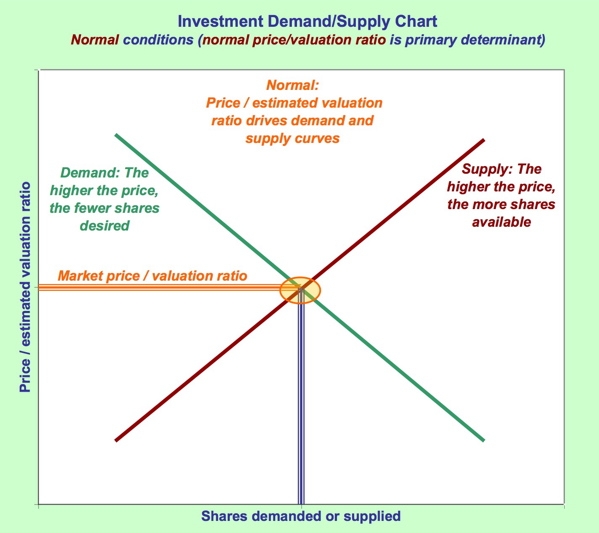
In investing, demand and supply usually is based on valuation (price relative to estimated worth). Therefore, a higher price deters demand and encourages supply, while a lower price has the opposite effect.
Next, let’s examine what happens in a bubble environment.
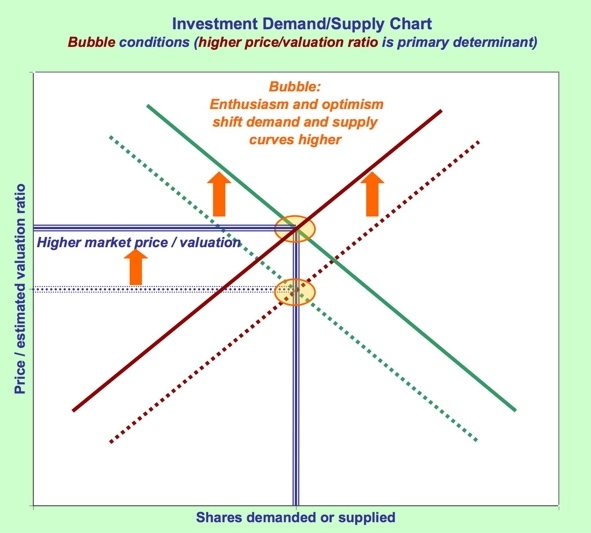
Here, enthusiasm and optimism drive prices up by raising valuations.
Finally, a bubble can morph into a blow-off.
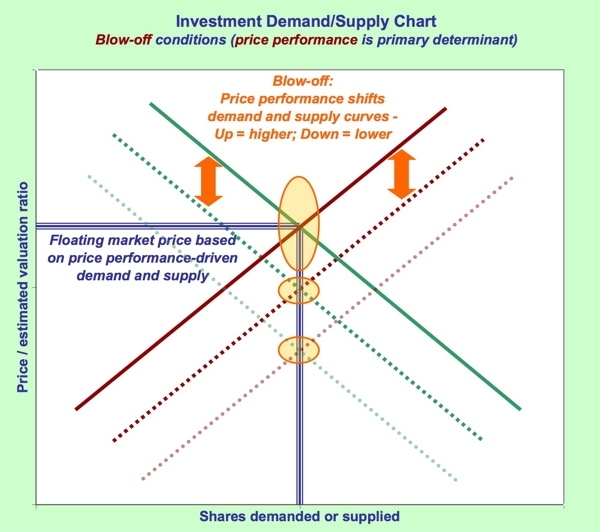
Rising prices themselves entice investors, thereby raising the demand and supply curves. This situation can produce a seemingly perpetual moneymaking machine: Price rise = increased demand + reduced supply = price rise. This phase has large gains and upward gaps at unsustainable rates of increase. Therefore, it is typically short-lived.
An ugly end
Blow-off endings are dismal. The moneymaking machine can quickly lose its price-rise driver, putting the machine in reverse: Price drop = reduced demand + increased supply = price drop. With fundamental support well below the price, the declines can be large and fast.
Spotting a reversal before it happens is very difficult. It’s dependent on a confluence of widely diversified beliefs, attitudes and situations.
So what about silver today? Will it rise again? Or is this week’s decline a sign of the turn? We will only know that answer in hindsight. The key point is that in a blow-off stage, fundamentals don’t matter – the direction of the price is everything.
Many are studying price charts to identify support levels. That might work, but silver’s rise was so rapid, it spent little time anywhere along the way. Here is the price chart of iShares Silver Trust (SLV):
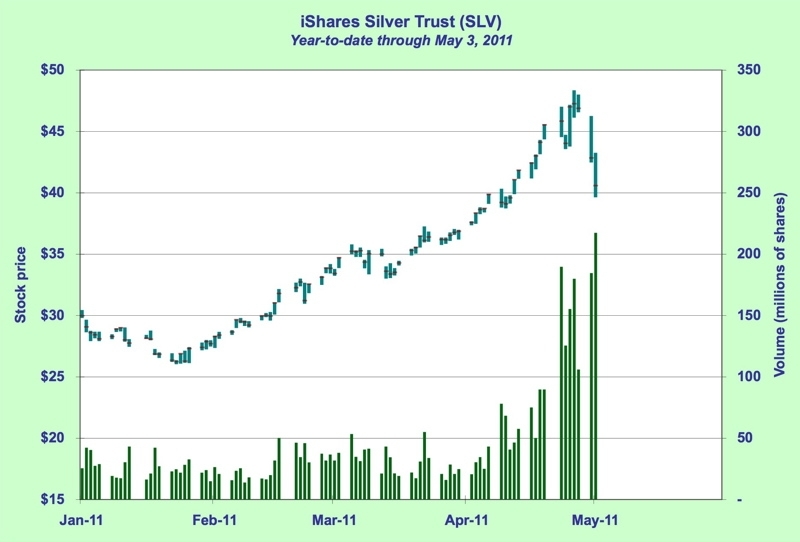
Another approach is to watch the percentage decline from last week’s high. Currently SLV is off about 17% (from about $48 to $40). A growth stock can suffer a drop of 15-20% and maintain its uptrend. However, a stock in a blow-off period may or may not recover. It’s all about holders’ and potential buyers’ view of the drop – whether it’s an opportunistic dip or a scary warning.
A final chart reading is trading volume. SLV has had significant volume around last week’s top and during this week’s decline. That pattern is more associated with liquidation than capturing an opportunity.
Now is a good time to remember the observation of successful investors: “I made money by selling too soon.”
Disclosure: I have no positions in any stocks mentioned, and no plans to initiate any positions within the next 72 hours.
(Source: http://seekingalpha.com/article/267588-silver-s-price-moves-are-affecting-investor-behavior)
Tuesday, 3 May 2011
India: MCX Silver tumbles on dollar recovery
 Silver tumbled yesterday on losing lustre of safe haven demand of the metal after al-Qaeda leader Osama bin Laden was killed on Monday.
The Comex raised margin requirement on Silver for the third time since last Monday. It increased maintenance margins for speculators by 11.6 percent per contract.
We expect silver to remain volatile as fundamentals of global uncertainties are still supporting metal where as the recovery in dollar may dampen gains.
The decline in holdings in the iShares Silver Trust, the world's largest silver-backed exchange-traded fund may discourage investors to remain long in the metal. Support in silver can be seen at Rs66500/kg.
Courtesy: Religare Commodities
India silver plunges tracking weak Asian shares
 The spot silver has lost the ground yesterday by as much as 8.53% to settle at $43.82. The same has been observed in futures in the COMEX and MCX division Silver for July delivery lost as much as 5.18% after the CME group increased the initial margin for speculative positions by 13%.
Global equities had a mix performance. The Asian equities were almost down, with DJIA also closed little down while FTSE was closed
The dollar index recovered after a slump put pressure on the metal to slid
The I-share silver holdings has came down a bit to 11021 tons from11053.2 tons as on 29th April
Outlook:
Silver plunged by 2.26% at $45.035 after the dollar index rebounds. At present the dollar index is up by 0.057% at 73.096
As discussed in gold’s outlook, the economic data which are yet to release from the US are mostly favorable to the economy and hence this may put little pressure on the metal. The stronger dollar index is also another factor for the metal to retreat. A likely increase in Indian REPO rate may make the rupee appreciate which will again be a negative catalyst for the metal.
Overall, it is likely for silver to open low and is likely to have a wide range bound movement.
Courtesy: Karvy Commtrade Ltd.
Silver Futures Plunge Most Since 2008 as CME Group Increases Margins 13%
 Silver futures plunged as much as 13 percent, the biggest intraday drop since October 2008, as CME Group Inc. raised the amount of cash that traders must deposit for speculative positions.
The metal for July delivery dropped to $42.2 an ounce before trading at $43.875 an ounce at 11:46 a.m. in Singapore. The CME increased margins by 13 percent with effect from the close on Friday, according to a statement.
Futures advanced 28 percent in April, the largest monthly gain since January 1983, and more than doubled in the past year as investors sought to protect their wealth against a weakening dollar and inflation. Federal Reserve Chairman Ben S. Bernanke signaled last week he will keep pumping record amounts of money into the world’s largest economy and reiterated a pledge first made two years ago to keep interest rates “exceptionally low.”
“We got massive sell orders in the spot market,” Jonathan Barratt, managing director at Commodity Broking Services Pty, said in a phone interview from Sydney today. “Those sorts of moves may be an indicator of a key reversal, but it will often take one or two weeks to unfold.”
Silver for immediate delivery slumped as much as 11 percent to $42.6775 an ounce and traded at $43.95. Gold for immediate delivery gained as much as 0.9 percent to a record $1,577.57 an ounce before reversing to drop 0.9 percent to $1,549.47.
Fewer Bullish Bets
Silver is the best performer this year on the Standard & Poor’s GSCI Index of 24 commodities. The metal led the way in April as commodities beat stocks, bonds and the dollar for a fifth straight month, the longest stretch in at least 14 years.
Gold increased 9.2 percent this year and is set for its 11th annual gain, while silver jumped 43 percent as investors increased their holdings in exchange-traded products to a record 15,518 metric tons on April 26.
Hedge-fund managers and other large speculators cut their net-long positions in New York silver futures by 26 percent in the week ended April 26, according to U.S. Commodity Futures Trading Commission data. Speculative long positions, or bets prices will gain, outnumbered short positions by 24,995 contracts on the Comex division of the New York Mercantile Exchange, according to the CFTC.
Initial margins increased to $14,513 per contract from $12,825 and maintenance deposits rose to $10,750 from $9,500, said CME, parent of Comex where the futures are traded.
More Expensive
Gold bought 35.07 ounces of silver today, 7.5 percent more than the 32.64 ounces on Friday.
The ratio “has come down to levels of about 30 recently after silver’s run-up, which means silver had become expensive in relative terms,” said Lee Joon, a senior trader at Woori Futures Co. inSeoul.
Silver surged after investment demand jumped 40 percent in 2010 as inflation gained, currencies lost value and Europe’s debt crisis escalated, according to London-based researcher GFMS Ltd. Industrial use gained 21 percent last year, it said.
Eastman Kodak Co., the 130-year-old imaging company, is raising prices and cutting its dependence on silver to cope with escalating costs, the company said last week.
“We put in place contingencies to deal with a significant increase” in the price, Antonio M. Perez, chairman and chief executive officer, said on a conference call. “We’re indexing our contracts. We’re hedging, and we’re moving as fast as we can with the part of the portfolio that has no silver dependence.”
“Profit-taking” seemed the most likely cause of the decline today, said Park Jong Beom, a Seoul-based trader at Tong Yang Futures Trading Co. “Silver has risen very fast.”
Palladium for immediate delivery fell 1.6 percent to $781 an ounce while platinum dropped 1.8 percent to $1,839.
Silver futures down on profit-booking, global cues
 NEW DELHI: Silver prices fell by 0.69 per cent to Rs 67,389 per kg in futures trade today as speculators engaged in booking profits amid overnight losses in global market.
At the Multi Commodity Exchange , silver for delivery in May dropped by Rs 467, or 0.69 per cent to Rs 67,389 per kg, with a business turnover of one lot.
Likewise, for delivery in July the white metal traded Rs 432, or 0.63 per cent lower at Rs 68,143 per kg, with an open interest of three lots.
Analysts said besides profit-booking by speculators at existing record level, the drop in its prices overseas in yesterday's trade, led to the fall in silver futures prices here.
Meanwhile, silver lost 13 per cent, the biggest intra-day drop since October 2008, at USD 42.10 an ounce in yesterday's trade in New York.
Silver Prices Tumble 12% After CME Hikes Margin
 NEW YORK (Dow Jones)--Two weeks of gains in the silver market were erased in 11 minutes as investors sought to avoid higher trading costs and cash out of a historic rally.
Silver prices tumbled 12% shortly after electronic trading opened in Asia for the week -- around 6 p.m. EDT on Sunday -- in a swift and violent cascade. Prices recouped some of the losses over the course of the trading session, but the most-active July silver futures contract closed down 5.2% at $46.084 a troy ounce on the Comex division of the New York Mercantile Exchange. After prices had settled for the day, silver futures staged another sharp drop in electronic trading.
Traders said the declines were triggered after Nymex raised its trading-deposit requirements, known as margins, over the weekend. To trade silver futures, investors typically pay only the margins, which cost a fraction of a contract's full value of around $230,000.
CME Group Inc. (CME), which operates the Nymex, had raised its margin requirement for speculative traders twice last week due to high volatility. These investors must now put up $14,513 per contract for a day trade, and a further $10,750 to keep that contract overnight. Both requirements are up 24% from a week ago. For investors holding hundreds of contracts, that's a difference of hundreds of thousands of dollars.
Silver is much less costly than gold, but gold's margin requirements are less than half of silver's. The higher margins are a deterrent to new investors looking to enter the market.
"That's going to scare the weaker hands out of the market immediately," said Ralph Preston, market analyst at Heritage West Financial.
Silver prices have nearly doubled in six months, and both silver and gold have zoomed to record levels on concerns about low U.S. interest rates, inflation and investor demand for an affordable store of value. Both metals are considered to be a safe haven when bearish sentiment pressures equities and the dollar. But the two markets don't always trade in concert.
Gold is very scarce and has few industrial uses. By contrast, silver is more abundant, and the metal's use in high-end electronics and manufacturing makes it sensitive to economic downturns.
However, "for the same money you could trade almost twice as many gold contracts," said George Gero, vice president with RBC Capital Markets.
Several market participants said silver's decline was accelerated by broker MF Global (MF), which they said raised its own margin requirements on top of CME's increase.
An MF Global spokeswoman declined to comment on whether the company had raised its margins.
Low trading volumes likely amplified silver's decline. It took less than 6,000 contracts changing hands, or around 3% of the day's trading volume, to knock prices to a two-week low on a day when many markets in Asia and Europe were closed. Gold has been less prone to such wild price swings as there are many more market participants trading gold futures, which reduces the influence of each individual transaction.
"This was panic-type selling. As the market started falling in the midst of thin volumes it drew more sellers to the market, and this created a vacuumed to the downside," said Dave Meger, director of metals trading at Vision Financial Markets.
Front-month May silver futures settled down 5.2% at $46.078 a troy ounce.
(Source: http://online.wsj.com/article/BT-CO-20110502-713744.html)
Silver Tumbles on Bin Laden News, Margin Requirement Increase, Technical Factors
 Silver saw a steep 10% plunge in today's trading, falling from its perch in last week's trading, after failing to move above the $49.50 level.
The news that Osama bin Laden was killed overnight helped to spur some gains in the USD, weakening oil and commodities, and lowering the risk premium that has been underpinning commodity prices.
Another important factor was the increase in margin requirments for those trading silver.
From Wall Street Journal : "Exchange operator CME Group Inc. ( CME ) raised margins for Comex silver futures for the second time this week as silver prices soar amid much volatility .
The higher margins take effect at the close of trading Friday, the exchange said. The CME revises its margin requirements as a normal course of business, and has previously raised bond requirements during times of high volatility to guard traders against additional risk. The operator owns New York Mercantile Exchange, which trades silver on its Comex division.
For speculators in the benchmark 5,000-ounce silver futures contract, the exchange is raising initial margin requirements, or the deposit required to purchase a contract, to $14,513 per contract, up from $12,825. Maintenance margin requirements, or the additional capital needed to keep the contract overnight, will increase to $10,750, from $9,500."
The combination of a reduction in risk premium plus the increase in margins came together to cause a strong reaction in the market. With silver rallying so strongly recently (170% over the last 12 months), professional traders scaled back silver exposure by 26% as of last Tuesday. That shows us that the recent gains may have been too strong, and that silver takes a break from its recent rally even as gold surged higher to end last week.
The preference for gold over silver may be shifting.
From Reuters : "Some traders put down silver's spectacular fall to an unwinding of a short gold-silver ratio position, compounded by automated stop-loss orders.
The gold-silver ratio, used to measure the number of silver ounces needed to buy an ounce of gold, rebounded to about 35 from below 32, its lowest level since the early 1980s."
The macroeconomic and political picture still favor previous metals, as long as the Fed continues to send signals that it will pursue a loose monetary policy, and that rates are not likely to move until early 2012. That makes selling USD and buying commodities a strong bet as metals and most other commodities prices in USD climb as a result of a weaker USD.
Issues regarding Euro -zone sovereign debt, US budget deficits and monetary policy, and the war in Libya, are just several factors that have kept gold and silver well bid in the past few months.
Today's session did see lower liquidity and so these moves may have been exaggerated. Still, an increase in volatility is seen when we get to market tops and bottoms, so this is an important time to monitor how the battle between bulls and bears plays out this week.
Some other rumors for the possible volatility in silver today, and recently.
From the Business Spectator : "The conspiracy theorists have had more than one theory.
The biggest is that a couple of the big US investment banks had long held massive short positions in silver and were caught out when the price started to move, creating in effect a short squeeze that has forced them to try to cover their positions.
Another is that China has been buying precious metals to try to diversify away from its exposure to US Treasuries, and yet another that Chinese traders are replicating a strategy they adopted with copper and using imports and stockpiles of silver as a way of circumventing China's restrictions on credit as it attempts to keep inflation under control. The traders can borrow against their commodity holdings.
At a more prosaic level, apart from the exchange-traded funds, there has been plenty of hedge fund and carry trade activity generally in all the key commodities, which may have helped fuel the price rise and which would unwind rapidly at the first hint of the price cracking."
We have key events on the schedule this week including interest rate decisions from the RBA, ECB, and BOE, as well as the April Non-Farm Payroll report. The ECB decision and the NFP especially will be important market movers, and will have a direct impact on risk appetite for commodities


